In the fields of semiconductor integrated circuits and advanced packaging, backside thinning and planarization of hard and brittle wafers such as silicon, silicon carbide, and sapphire are core processes.
However, after tens to hundreds of micrometers of material removal, a subsurface damage (SSD) layer containing microcracks, amorphous phase transformation, and residual stress inevitably forms near the wafer surface.
As chips evolve toward thicknesses below 100 μm, the industry’s tolerance for the damage layer has been compressed to within 1–3 μm. This damage layer directly affects the removal amount in subsequent CMP, the risk of wafer fracture, and even the reliability of final devices.
In ultra-precision grinding, the spindle is the “heart” that determines material removal stability. However, even with ultra-precision bearings, the spindle still generates micro-amplitude vibration during high-speed rotation.
When vibration is superimposed on the theoretical depth of cut, causing the instantaneous chip thickness to exceed the brittle-to-ductile transition critical depth, cracks initiate and propagate instantly.
Therefore, how to control subsurface damage from the source through “low-vibration spindle” technology has become a key challenge urgently requiring a breakthrough in the industry.
Why is spindle micro-vibration a “hidden killer”?
1. Fatal perturbation of the cutting mode
Ideally, when the depth of cut by a single abrasive grain is less than the critical depth, the material is removed by plastic flow. However, spindle vibration introduces dynamic displacement, causing the actual depth of cut to vary violently at high frequency.
Once the instantaneous chip thickness exceeds the limit, the brittle fracture mode is activated, generating lateral and median cracks. Crack depth is approximately linearly and positively correlated with vibration amplitude.
2. Resonance amplification through frequency coupling
Looking only at the amplitude peak is not enough. When the vibration frequency overlaps with the natural frequency of the spindle system, structural resonance occurs, causing the subsurface damage depth to suddenly amplify several times.
High-frequency vibration (>1 kHz): mostly acts on surface roughness, forming brittle pits.
Low-frequency vibration (<500 Hz): deepens median crack depth and dominates the overall SSD thickness.
3. “Aftereffects” left by energy dissipation
Part of the impact energy added by vibration is stored in the wafer in the form of residual stress. Studies show that spindle axial vibration acceleration (RMS) is positively correlated with subsurface residual stress. Under high-vibration environments, the thickness of the residual compressive stress layer can increase by 20%–40%, becoming a potential source of wafer warpage and hidden cracks.
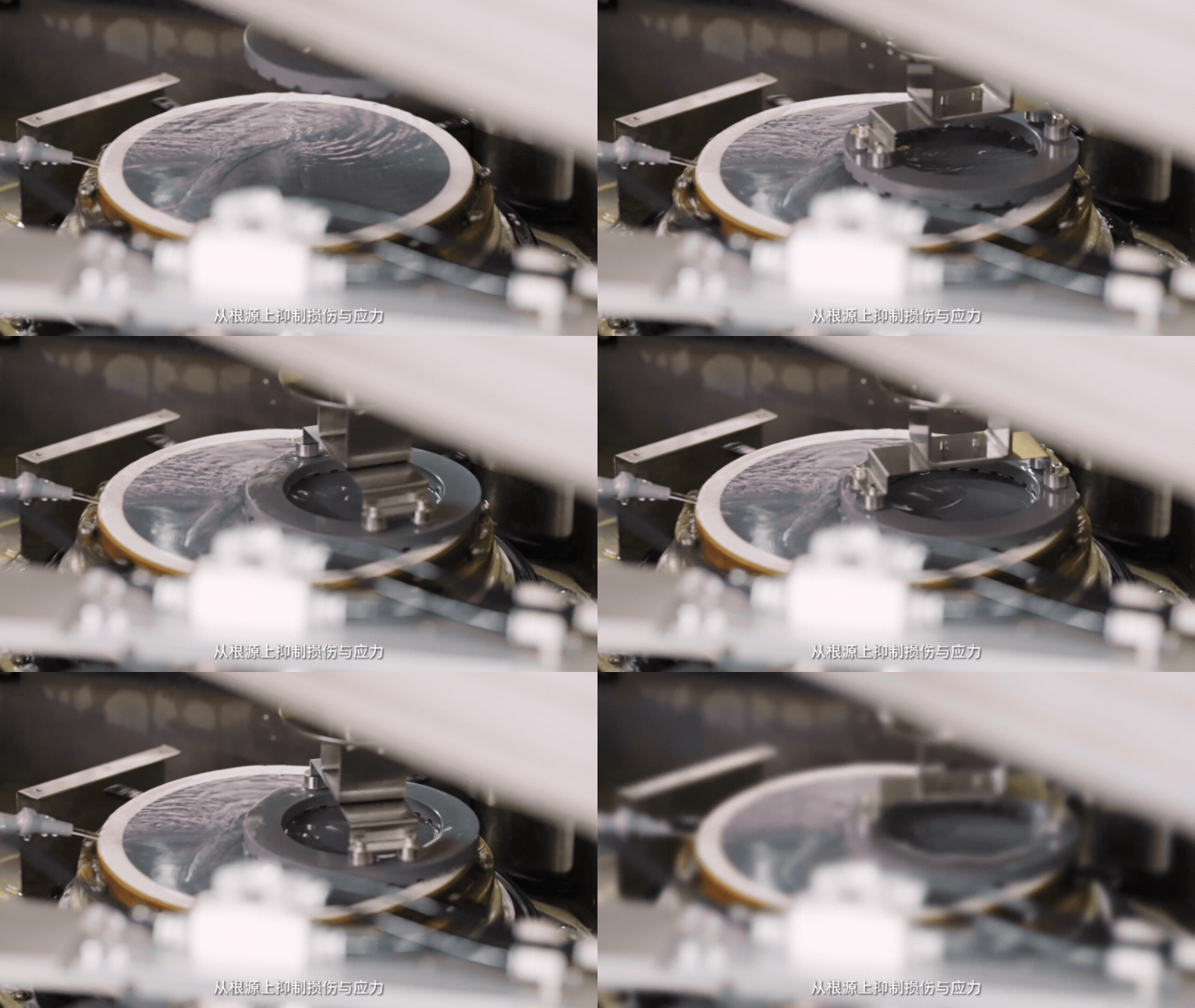
Letting data speak: how is vibration quantified?
To precisely quantify the impact, it is necessary to establish a mapping between vibration data at the spindle end and damage parameters at the wafer end.
Mainstream detection methods include:
Cross-sectional microscopy: statistically determine the maximum crack depth.
Laser confocal Raman spectroscopy: nondestructively obtain amorphous layer depth and residual stress.
Transmission electron microscopy (TEM): precisely measure the thickness of the outermost amorphous phase transformation layer (usually 50–200 nm).
The data comparison is striking:
Traditional rolling-bearing spindles typically have vibration levels on the order of 0.1–0.5 μm, while excellent low-vibration spindles (such as aerostatic bearings) can have V_rms as low as 5–15 nm.
In typical SiC wafer grinding tests:
When the spindle V_rms decreased from 0.2 μm to 0.02 μm, the maximum subsurface crack depth was compressed from 8.2 μm to 2.3 μm—a reduction of 72%—and damage distribution uniformity improved by nearly 50%.
How to build an ultimate low-vibration spindle?
Achieving extreme control of subsurface damage requires integrated optimization of the spindle system across “structure–drive–sensing–control.”
① Configuration design upgrade
Aerostatic bearings: excellent rotational accuracy (<50 nm), suitable for combination with active dampers.
Active magnetic bearings: actively suppress rotor vibration over the full speed range, oriented toward intelligent machining.
Composite material rotors: increase the critical speed, move away from common grinding speed ranges, and avoid resonance.
② Active vibration suppression
Integrate piezoelectric ceramic actuators near the spindle. Experiments show that for synchronous vibration caused by grinding wheel unbalance, active damping can attenuate the axial amplitude at the grinding wheel end face by 80%–90%, directly bringing nearly 40% improvement in subsurface damage depth.
③ Process adaptive matching
Establish a process–vibration–damage digital map. When an abnormal vibration increase is monitored, actively fine-tune the spindle speed or feed rate to transfer vibration energy out of the dangerous frequency band.
④ Digital twin prediction
Through edge computing that fuses multi-sensor information, online output of predicted SSD depth is achieved. This advances subsurface damage from “post-inspection” to “online assurance and control.”
From theory to equipment: Siplus’s engineering implementation
Quantitative theoretical models ultimately need to be implemented through high-precision industrial equipment.
In this frontier field, the thinning equipment from Siplus Semiconductor provides an excellent engineering demonstration. Its core is a high-rigidity, ultra-precision air spindle.
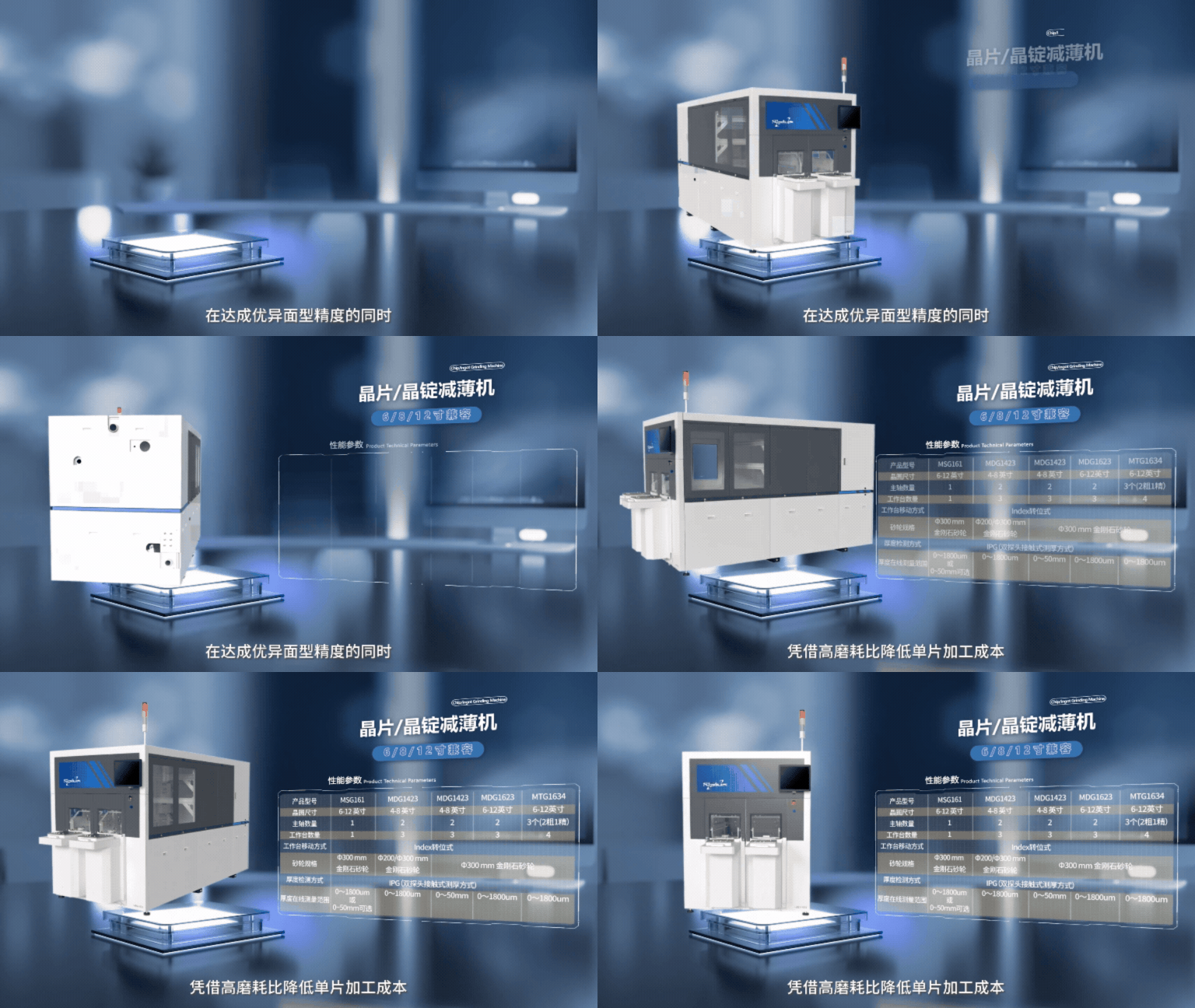
By integrating extreme spindle dynamic balance control with a low-stress grinding process, Siplus not only achieves nanoscale vibration suppression at the equipment level, but also effectively suppresses microcracks and amorphous layer thickening on the wafer surface in actual mass production. It provides a stable, mass-producible solution path for subsurface damage control in hard and brittle materials such as silicon carbide.
When vibration displacement is compressed to the sub-nanometer level, new noise sources such as microscopic material inhomogeneity will become new challenges. In the future, with the introduction of new-generation sensing technologies such as physics-informed neural networks (PINN) and quantum magnetic sensing, the spindle will evolve from a “precision component” into a true “damage-immune machining unit.”
Continuously promoting innovation in low-vibration spindle technology is an indispensable equipment foundation for realizing near-damage-free ultra-precision wafer processing.